
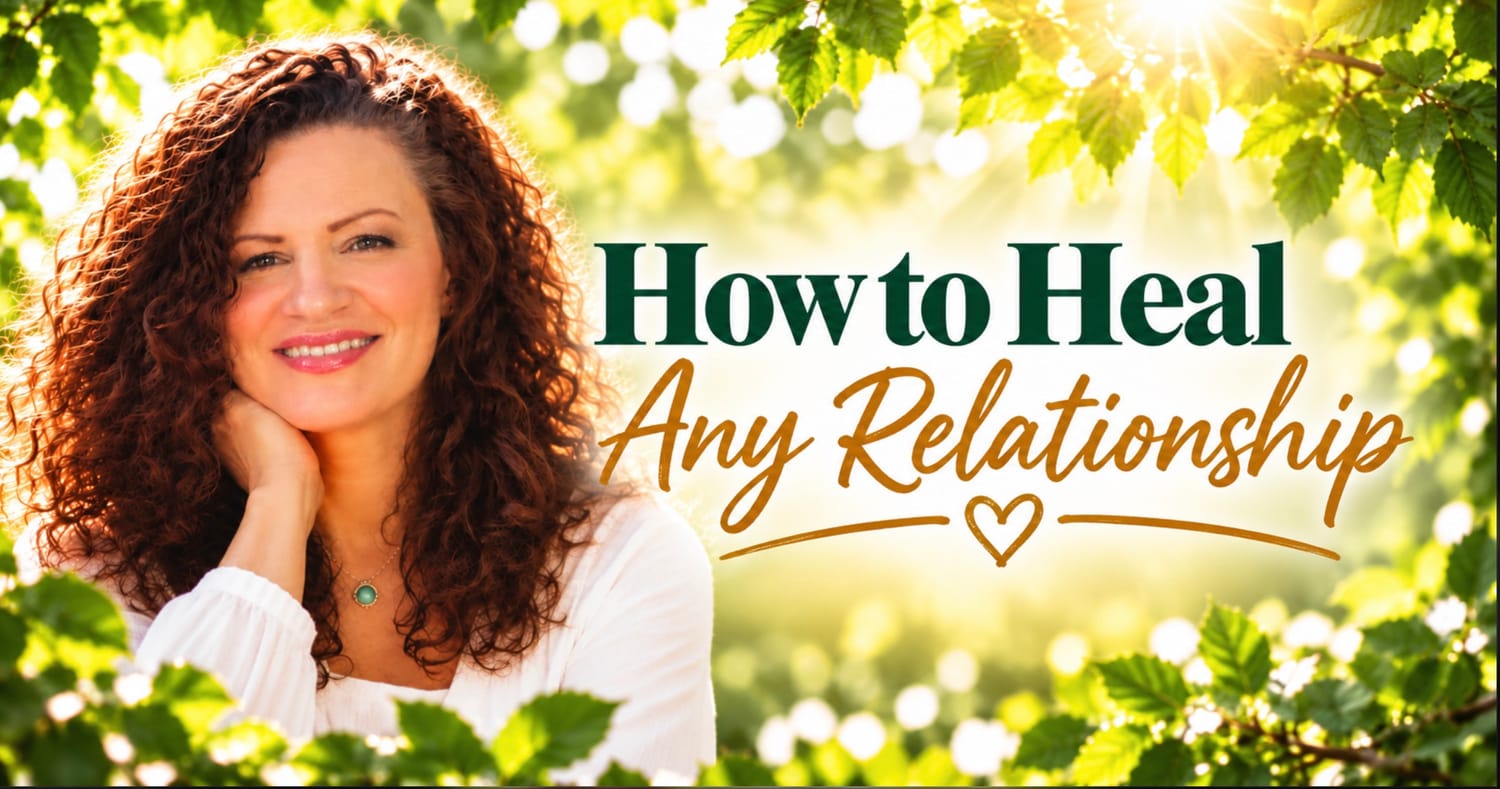
Relationship & Communication Expert
Creator of the free masterclass, How to Heal Any Relationship.
Discover the One Skill That Can Turn Conflict Into Connection—Even When the Other Person Isn’t Yet Ready for Change
Have you ever tried to have an important conversation with someone you love, only to have it turn into an argument?
You start out wanting to be understood. You want to explain how you feel, resolve something that's bothering you, or simply feel closer to the other person.
But somehow, the conversation goes sideways.
Before you know it, you're defending yourself, blaming the other person, or saying things you wish you hadn't.
And afterward, you feel even more disconnected than before.
What if you could have difficult conversations without fighting—even if the other person doesn't change?
Through my work as a relationship and communication expert, I've discovered something that has transformed how I approach conflict and how I help others navigate their most challenging relationships.
The secret isn't finding the perfect words.
It isn't convincing someone to see things your way.
And it certainly isn't learning how to win an argument.
It begins with understanding yourself.
Why Difficult Conversations Turn Into Arguments
One of the biggest mistakes people make when entering a difficult conversation is that they don't actually know what they need.
They know they're upset. They may feel hurt, resentful, disappointed, or overwhelmed.
But underneath those emotions, there's often something much deeper they haven't recognized.
Think of your mind like a computer.
When too many applications are running simultaneously, the computer slows down. It becomes overloaded and struggles to perform even simple tasks.
Our minds work much the same way.
When we're overwhelmed with emotions, judgments, assumptions, and hurt feelings, communicating clearly becomes incredibly difficult.
Instead, we react.
We blame.
We take things personally.
And the message we really want to communicate gets lost.
The first step toward having a peaceful conversation isn't figuring out what to say to the other person. It's getting clear about what's happening inside you.
A Real Story: When Resentment Was Actually a Longing for Love
Let me share a story from my work with a couple.
A woman came to me feeling deeply resentful toward her husband.
She was frustrated, hurt, and seriously considering leaving the marriage.
From her perspective, her husband wasn't being the partner she needed him to be. She felt disconnected, unappreciated, and increasingly unhappy.
But as I guided her through a process I teach called The Compassionate Connection Method™, something remarkable happened.
We began by helping her connect with her feelings.
Rather than pushing away her resentment or trying to justify it, she gently turned toward what she was experiencing.
Then we explored what she was actually needing beneath those feelings.
Suddenly, she began to cry.
She realized something she hadn't been able to see before.
She didn't really want to leave her husband. She missed him.
She missed their connection.
She missed their playfulness.
She missed greeting each other with affection in the morning, a kiss at the end of the day, and those simple moments of asking how each other's day had been.
Underneath all that resentment was a deep longing for connection, appreciation, and acceptance.
What she thought she wanted—distance from her husband—was almost the exact opposite of what she actually needed.
And that realization changed everything.
From Resentment to Compassion

Once she understood her own feelings and needs, we moved to the next step.
I invited her to consider what her husband might be experiencing.
Was it possible that his distance wasn't about her at all?
As she considered what might be happening in his life, she began to recognize that he was dealing with challenges of his own.
Her perspective shifted.
Instead of seeing him as someone who was failing her, she began to see him as another human being who might also be struggling.
The resentment began to soften, and compassion took its place.
Then something beautiful happened.
She knew what she wanted to do.
She decided to invite her husband on a date.
They went to dinner, enjoyed time together, and she was finally able to express what had been happening inside her.
But this time, instead of criticizing him, she told him how much she missed him.
She shared her desire to feel close again and acknowledged that he might have a lot going on.
Rather than feeling attacked, her husband was touched by her desire to reconnect.
They had an honest, compassionate conversation and experienced the closeness she'd been longing for.
What had initially looked like a relationship moving toward separation became an opportunity for deeper connection.
The circumstances hadn't magically changed. Her understanding had. And that changed the conversation.
The Three Steps to Having Difficult Conversations Without Fighting
The Compassionate Connection Method™ is a practical, step-by-step approach I've developed to help people move from emotional overwhelm to clarity, compassion, and meaningful connection.
Drawing on principles of Nonviolent Communication, developed by Marshall Rosenberg, this method provides a clear roadmap anyone can learn and practice.
It involves three essential steps.
Step 1: Self-Empathy—Understand Yourself First
Before entering a difficult conversation, begin with yourself.
Instead of focusing on what the other person did wrong, gently turn your attention inward.
Ask yourself:
- What am I actually feeling right now?
- What am I telling myself about this situation?
- What am I needing that I'm not experiencing?
- What matters most to me in this relationship?
You might discover that underneath your anger is sadness.
Underneath your resentment is a longing for appreciation.
Underneath your frustration is a desire to be understood.
This is self-empathy.
Rather than resisting your emotions, you acknowledge them with compassion.
Research suggests that simply naming our emotions can help regulate our emotional responses.
In my experience, when people begin to understand what they're feeling and needing, they often experience an immediate sense of relief.
It's as though the emotional pressure begins to release.
The situation becomes clearer, and they can finally recognize what they really want.
Step 2: Empathy—Understand the Other Person
Once you've connected with yourself, the next step is to consider the other person's experience.
This doesn't mean agreeing with their behavior, excusing hurtful actions, or abandoning your own needs.
It simply means recognizing that the other person has feelings and needs, too.
Ask yourself:
- What might they be feeling?
- What might they be needing?
- What challenges could they be experiencing that I don't know about?
- Is it possible I've been taking something personally that isn't actually about me?
You don't have to know the answers.
Simply being willing to consider another perspective can soften judgment and open the door to compassion.
One of the most liberating realizations we can have is that another person's behavior isn't necessarily a reflection of our worth.
When we stop taking everything personally, we become much more capable of responding with understanding instead of defensiveness.
And that creates emotional safety.
Step 3: Insight—Discover Your Next Step
Here's where something remarkable often happens.
Once you've connected with your own feelings and needs and considered the other person's experience, the next step frequently becomes clear.
Instead of forcing a solution, you begin to recognize what would genuinely support connection.
You might realize you need more quality time, greater understanding, appreciation, or cooperation.
You might discover that you need to establish a healthy boundary.
And now you can make a clear, compassionate request.
For example, instead of saying:
"You never spend any time with me. You obviously don't care about our relationship."
You might say:
"I've been feeling lonely lately, and I've realized how much I miss spending time together. Would you be willing to plan an evening this week when we can reconnect?"
Notice the difference.
The first statement invites defensiveness.
The second invites connection.
You're expressing the same underlying concern, but you're communicating from clarity rather than hurt.
When you understand what you need, you can ask for it without making the other person wrong.
The One Thing You Can Do Immediately to Prevent an Argument
There's one simple practice I encourage everyone to begin using today.
Pause.
When you're upset, overwhelmed, or about to say something you might regret, pause.
Take a breath.
Remember that you have a choice.
Psychiatrist and Holocaust survivor Viktor Frankl emphasized our capacity to choose how we respond, even in extraordinarily difficult circumstances.
That principle has profound implications for our everyday relationships.
Just because someone says something hurtful doesn't mean you have to react.
Just because you feel angry doesn't mean you have to speak from anger.
You can pause.
You can take a breath.
You can give yourself space.
Sometimes the most compassionate thing you can say is:
"I'm feeling overwhelmed right now, and I really want to have this conversation in a way that's helpful. Can we take a little break and come back to it?"
You're not avoiding the conversation. You're creating enough space to respond consciously rather than react automatically.
Sometimes that one small choice can change the entire direction of a conversation.
Can One Person Really Transform a Relationship?
This is one of the questions I hear most often.
"What if my partner won't change?"
"What if my child refuses to communicate?"
"What if I'm the only one willing to work on the relationship?"
Here's what I've discovered through years of helping people navigate difficult relationships.
You don't have to wait for someone else to change before you can begin changing your experience of the relationship.
I've witnessed countless situations where one person learning to communicate differently has profoundly influenced a relationship.
Why?
Because relationships are interactive.
When you change the way you respond, you change the dynamic.
When you stop criticizing, the other person may become less defensive.
When you communicate your needs clearly, the other person has a better opportunity to understand you.
When you approach someone with empathy, you create greater emotional safety.
And when people feel emotionally safe, they're often more willing to listen, open up, and connect.
Of course, you cannot control another person's response, and some relationships require firm boundaries or additional support, particularly when safety is a concern.
But you have far more influence over your own experience than you might realize.
You can begin creating change without waiting for someone else's permission or participation.
And that is incredibly empowering.
Why Knowing This Skill Isn't Enough
There's one important thing I want you to understand.
Learning about compassionate communication isn't the same as knowing how to practice it when you're upset.
You can read every book on communication and understand the principles intellectually.
But when someone you love says something hurtful, all that knowledge can disappear in an instant.
That's why practice matters.
Think about learning to ride a bicycle.
You can read about riding a bike and understand exactly how it works.
But until you actually get on the bicycle and practice, you haven't developed the skill.
Compassionate communication works the same way.
You need to practice self-empathy when you're not in the middle of a crisis.
You need opportunities to practice offering empathy to others.
And especially in the beginning, it helps tremendously to practice with people who understand the process.
That's why I've developed programs, practice circles, and resources to help people integrate these skills into everyday life.
My goal isn't simply to teach people what compassionate communication means.
It's to help people become so comfortable with these skills that compassion becomes their natural response—even in difficult moments.
Emotional First Aid for Your Relationships
I often think of the Compassionate Connection Method™ as a form of emotional first aid.
When you're hurting, overwhelmed, or feeling disconnected, you need something practical.
You need relief, clarity, and a way to understand what's happening and what to do next.
That's what this method offers.
A practical way to care for yourself emotionally, understand others more deeply, and move toward resolution.
But the benefits extend far beyond difficult conversations.
As you practice, you may find yourself making decisions with greater clarity.
You may discover that you're less affected by other people's moods and reactions.
You may experience more compassion toward yourself.
And you may begin showing up in your relationships as the person you've always wanted to be.
More peaceful.
More confident.
More understanding.
More connected.
Because learning how to have difficult conversations without fighting isn't just about improving communication. It's about transforming your relationship with yourself—and from that place, transforming how you relate to others.
You Can Begin Changing Your Relationships Today
If you're struggling in a relationship right now, I want you to know something.
You don't have to figure everything out today.
You don't have to convince the other person to change.
And you don't have to wait until your relationship reaches a breaking point.
You can start with one simple practice.
The next time you feel yourself getting upset, pause.
Take a breath.
Ask yourself what you're really feeling and needing.
Remember that underneath many of our most painful emotions is something deeply human: a desire for connection, understanding, acceptance, appreciation, or love.
When you learn to recognize those needs in yourself and others, difficult conversations no longer have to be battles.
They can become opportunities for understanding.
And sometimes, they can even bring you closer than you were before.
Ready to Turn Conflict Into Connection?
If you're tired of difficult conversations turning into arguments, I'd love to introduce you to The Compassionate Connection Method™.
In my upcoming free masterclass, “How to Heal Any Relationship”, I'll show you how this simple yet profound approach can help you understand yourself and others more deeply, communicate your needs clearly, and begin creating more peaceful, meaningful relationships.
You don't need your partner, child, or anyone else to participate before you can begin.
You can start with yourself.
And with practice and support, you can develop a skill that serves you in every relationship throughout your life.
Join my next free masterclass, “How to Heal Any Relationship”, and discover how to turn confusion into clarity and conflict into connection.
Rachel Cutts
Relationship & Communication Expert
Creator of The Compassionate Connection Method™


